
WE SHIP NATIONWIDE ACROSS THE UNITED STATES AND CANADA. SPEAK TO AN EXPERT: 708-400-7000

8 hours ago

Can You Replace Just the Outside AC Unit? What Homeowners Need to Know

If your central air conditioner’s outdoor unit fails, replacing the entire cooling system may seem like the obvious next step. But that is not always necessary.


In some situations, you can replace the outside AC unit and continue using the existing indoor equipment. The important part is determining whether the new condenser can properly work with the evaporator coil, furnace or air handler, refrigerant, controls, and other components already in place.


That means a condenser-only replacement should not be based on tonnage alone. Before ordering equipment, the complete system needs to be evaluated.

First, What Does “Outside AC Unit” Mean?

The terminology can get confusing because homeowners often use “condenser” to describe the entire outdoor cabinet.


In a typical split central air conditioning system, the outdoor condensing unit contains several components, including the compressor, condenser coil, fan, and electrical components. Inside the home, an evaporator coil absorbs heat from the indoor air while the outdoor equipment releases that heat outside.


So there are two different repair conversations that can sound similar.


A technician may be talking about replacing an individual part inside the outdoor unit, such as a fan motor or capacitor. That is a repair to the existing condenser.


Replacing the entire outdoor condensing unit is different. You are introducing a major new component that must operate correctly with the indoor half of the air conditioning system.

This article focuses on that second situation.

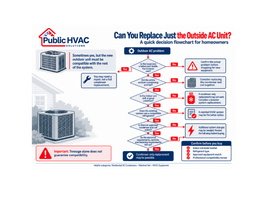
Can you just replace the outside AC unit flowchartCan you just replace the outside AC unit flowchart

Can You Replace the Outside AC Unit Without Replacing the Indoor Coil?

A condenser-only replacement may be possible when the indoor equipment is still in suitable condition and an outdoor unit is available that is compatible with it. Compatibility is the key word.


The fact that both units are labeled 3 ton, 4 ton, or another matching nominal capacity does not prove they belong together. The indoor and outdoor components operate as one refrigeration system, so several equipment characteristics have to line up.

The replacement condenser may need to be evaluated for:


• Refrigerant compatibility

• Cooling capacity

• Evaporator coil compatibility

• Approved equipment combinations

• Compressor and operating configuration

• Electrical requirements

• Metering and refrigerant circuit requirements

• Controls and other model-specific requirements


A qualified HVAC professional should confirm the existing indoor equipment and the proposed outdoor unit before the condenser is purchased.


If you are beginning that search, Public HVAC Solutions offers residential AC condensers in different capacities and configurations.

When Replacing the AC Condenser Only May Make Sense

Replacing just the outdoor unit becomes more practical when the rest of the cooling system still has useful service life and compatible replacement equipment can be identified.


Imagine an outdoor unit that has experienced a major failure while the indoor coil is considerably newer. If the indoor coil is in good condition and there is a compatible condenser available for that specific equipment combination, replacing the condenser without replacing the coil may be worth considering.


The same reasoning can apply when one major component was replaced earlier than the other. HVAC components do not always fail at the same time.


There still needs to be a reason to keep the indoor equipment beyond avoiding another purchase. Its condition, configuration, refrigerant, and compatibility with available condensers all matter.


This is why a condenser-only decision begins with identifying what you already have, not simply shopping for another outdoor unit with the same tonnage.


When a Condenser-Only Replacement Becomes More Difficult

Older or incompatible indoor equipment can change the decision quickly.


Refrigerant is one of the first issues to check. Central AC equipment has been produced for different refrigerants over the years, and equipment intended for one refrigerant cannot simply be assumed to work with equipment made for another.


This matters even more as newer condensers enter the market. A homeowner with an older indoor coil should not assume a current outdoor unit can be attached to it because the capacity is similar.


The indoor coil may also lack an approved match with the condenser being considered. Differences in system design, metering, airflow, controls, and equipment generation can create additional limitations.


At that point, trying to replace the condenser without the coil may create more complications than replacing the cooling components together.


The condition of the remaining equipment matters too. If the indoor coil is already deteriorated, leaking, or approaching another likely replacement decision, putting a new condenser beside it deserves a closer look.

Why Condenser and Coil Compatibility Matters

The condenser and evaporator coil perform different jobs, but they are part of the same refrigeration circuit.


That relationship is why efficiency ratings and capacity should be considered at the system level rather than treating the outdoor unit as completely independent equipment. A condenser may have a published efficiency level when paired with specific indoor equipment. That does not mean it will provide the same rating with any coil of the same tonnage.


Proper matching also affects how the refrigeration system operates.

Before buying an AC condenser replacement, identify the complete model information for the existing indoor and outdoor equipment whenever possible. The equipment nameplates are a useful starting point. Your HVAC professional can use that information to determine which replacement options should be considered.


If keeping older components creates too many compatibility questions, a matched HVAC set may be a more straightforward direction because the major components are selected to work together.

Questions to Answer Before You Replace Part of an AC System

Homeowners understandably tend to start with two questions: “What size is my current AC?” and “How much is a new condenser?” Those are useful questions, but they do not tell you whether a particular outdoor unit belongs on your existing system.


Before ordering equipment, get answers to questions such as:


What refrigerant does the existing system use?

Check both the existing condenser and indoor equipment rather than assuming.


What is the exact model number of the indoor coil?

The model number provides more useful compatibility information than tonnage by itself.


Is the proposed condenser approved to operate with that indoor equipment?

A similar capacity does not make two components a matched combination.


What condition is the indoor coil in?

Keeping an existing coil makes more sense when it is still in suitable operating condition.


Are there other installation changes required?

Electrical requirements, refrigerant piping, controls, metering components, physical dimensions, and other installation details may differ between equipment generations.


Your HVAC installer should review the proposed combination before you place the order. That is especially important when you are purchasing the equipment yourself.

Should You Replace the Condenser and Coil Together?

Keeping the indoor coil can make sense if it is in good condition and compatible with an available replacement condenser. Replacing both components may make more sense when compatibility is limited, the indoor coil also needs attention, or the project involves moving to a different equipment generation or refrigerant.


Another option is replacing more of the system as a matched set. That does not mean every condenser failure requires a complete HVAC replacement. It simply gives you another path when piecing a new outdoor unit into an older system is not practical.


If you are still determining how much equipment needs to be replaced, browsing the broader HVAC equipment selection can help you compare individual components with complete-system options.

Before Buying a Replacement Outside AC Unit

Yes, you may be able to replace just the outside AC unit. But the decision should be based on the complete HVAC system, not the outdoor unit by itself.


Start by identifying the existing condenser and indoor coil model numbers, refrigerant, capacity, and overall equipment condition. Then have an HVAC professional confirm that the replacement equipment is properly matched before ordering.


If a compatible component replacement exists, you may not need to replace equipment that still has useful life. If it does not, replacing the condenser and coil together or moving to a matched system may provide a cleaner path forward.