What Homeowners Should Know Before Buying HVAC Equipment Online
Buying heating and cooling equipment separately from installation can give homeowners more control over the purchase. It also changes who is responsible for confirming the details before the order is placed.
If you plan to buy HVAC equipment online, do not treat it like a standard appliance purchase. A furnace, air conditioner, heat pump, coil, or complete split system has to fit the home, work with the other components, meet the installation requirements, and arrive in usable condition.
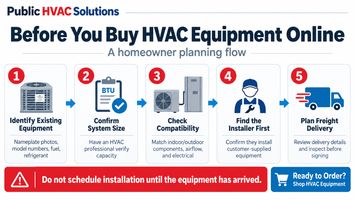
Public HVAC Buying Equipment Online Process
Buying the Equipment Yourself Changes the Order of the Project
In a traditional replacement, the HVAC contractor usually selects the equipment, supplies it, and installs it. When you buy your own HVAC system, those steps are separated.
That can work well, but the installer should be involved before the equipment is ordered. Some contractors install customer-supplied HVAC equipment and some do not. Finding the installer first lets you confirm what they will install, whether they want to review model numbers, and what their labor quote includes.
Gather More Than the Tonnage or BTU Rating
The size printed on the old equipment is useful, but it is not enough by itself to select a replacement.
Before asking an online HVAC supplier or installer to help identify equipment, gather as much of the following as you can:
• Clear photos of the existing equipment nameplates
• Complete manufacturer and model numbers for the furnace, air handler, condenser, heat pump, and indoor coil that will remain or be replaced
• Cooling capacity or tonnage and heating input or output when available
• Fuel type and refrigerant
• Voltage and electrical phase
• Equipment orientation, cabinet dimensions, and available installation space
• Information about the duct system, venting, drain, electrical service, and refrigerant line set
If the home has been remodeled, added onto, air sealed, or significantly insulated since the existing system was installed, mention that too. The old equipment is a reference point, not proof that the same size should automatically be ordered again.
Do Not Size a New HVAC System From Square Footage Alone
Square footage helps start the conversation, but it is not a complete HVAC sizing method. Two homes with the same floor area can have different heating and cooling loads because of insulation, windows, air leakage, ceiling height, orientation, climate, and other building characteristics.
For a full system replacement, have a qualified HVAC professional confirm the required heating and cooling capacity before you buy. A residential load calculation evaluates the home rather than relying only on the size of the existing equipment or a simple square-feet-per-ton rule.
Compatibility Matters as Much as Capacity
A 3-ton condenser is not automatically compatible with every 3-ton indoor coil. The same principle applies to furnaces, air handlers, heat pumps, thermostats, and other connected components.
If you are replacing only part of a split system, your installer should confirm the complete equipment combination before you order. Refrigerant, metering components, airflow requirements, cabinet size, controls, efficiency configuration, and electrical requirements can all affect whether components can operate together as intended.
This is especially important with older systems. Product generations and refrigerants change, so finding a unit with a similar capacity does not guarantee a direct replacement.
If you do not want to piece together individual components, a matched HVAC system can make equipment selection more straightforward because the major components are intended to be paired.
Find an Installer Before You Click Buy
Do not assume every local HVAC company will take an installation-only job. Call contractors before ordering and be specific that you plan to supply the equipment.
Ask whether they install homeowner-supplied equipment, whether they want to approve the exact model numbers first, and what their labor quote includes. Discuss removal of the old equipment, duct changes, electrical or gas work, refrigerant line work, drains, startup and testing, permits, and disposal.
Also ask what happens if the equipment you purchased does not fit the job. Buying the equipment yourself does not make the installation a DIY project. Refrigerant, fuel, electrical, venting, and commissioning work should be handled by qualified professionals.
Plan for Freight Delivery Before Scheduling Installation
Large HVAC equipment commonly ships by freight, so delivery is different from a small parcel left at the front door.
Public HVAC Solutions advises customers not to schedule installation or replacement until the equipment has been received. Freight transit can vary, and a delay can leave you paying an installer for a day when the equipment is not there.
For qualifying shipments, delivery may be curbside rather than inside the home or garage. Lift gate service can be available at an additional cost, subject to local freight-terminal availability. Review the delivery setup before ordering.
When the shipment arrives, count the pieces and inspect the equipment before signing the delivery receipt. Note visible damage or shortages on the receipt and follow the seller's reporting instructions.
What to Have Ready When You Ask Public HVAC Solutions for Help
You do not need to understand every model number before contacting Public HVAC Solutions. You will get a more useful answer, though, if you can show what you have and explain what you are trying to replace.
Start with photos of the existing equipment nameplates and full model numbers. Include the type of system, which components you want to replace, and any information your installer has provided about required capacity or compatibility. If you are replacing only an outdoor unit, include the indoor coil and furnace or air-handler information too.
Mention unusual space limitations, an older refrigerant system, nonstandard electrical service, or a planned change from the existing configuration. Those details can narrow the search faster than square footage alone.
Common Mistakes to Avoid Before Ordering
Do not choose a unit only because its tonnage or BTU rating matches the old one. Do not buy one component without checking the equipment it must work with. Do not schedule installation before the shipment arrives. And do not assume a contractor will install customer-supplied equipment without asking first.
The lowest equipment price also should not be the only deciding factor. A unit that cannot be used with the rest of the system is not a bargain.
Buy HVAC Equipment Online With the Installation Already Planned
Before checkout, ask four questions: Has the required capacity been professionally confirmed? Has the equipment combination been checked for compatibility? Have you found an installer willing to install the exact equipment? Do you understand how the shipment will be delivered and inspected?
If any answer is uncertain, resolve it before ordering. Returning large HVAC equipment can be more complicated and expensive than correcting the specification before it ships.
Homeowners who buy HVAC equipment online can separate the equipment purchase from installation, but those decisions still need to work together. Confirm the technical details, coordinate with the installer, and plan for delivery before setting an installation date.