WE SHIP NATIONWIDE ACROSS THE UNITED STATES AND CANADA. SPEAK TO AN EXPERT: 708-400-7000

3 days ago

80% vs. 95% AFUE Furnace: What to Compare Before Buying

If you're replacing a gas furnace, you may quickly run into two common efficiency ratings: 80% AFUE and 95% AFUE. At first glance, comparing an 80 vs 95 furnace seems simple. The 95% model uses more of the fuel it consumes to heat the home.


That difference matters, but efficiency is only part of the buying decision.


An 80% and a 95% furnace can differ in how gases are vented, if drainage is required, and what changes may be needed during installation. Your existing furnace setup can have a major influence on which option makes sense for a replacement.

What Does 80% or 95% AFUE Mean?

AFUE stands for Annual Fuel Utilization Efficiency which measures how efficiently a gas furnace converts fuel into usable heat over a typical heating season.


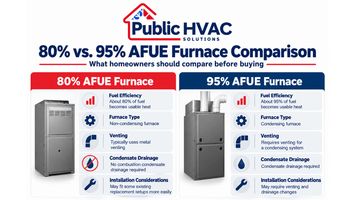
An 80% AFUE furnace converts about 80% of the fuel's energy into useful heat, with the remaining energy leaving through the venting system. A 95% AFUE furnace converts about 95% into useful heat.


That does not mean a 95% furnace will automatically reduce every homeowner's heating bill by 15%. Actual fuel use depends on the home's heating load, climate, thermostat settings, equipment sizing, duct system, fuel prices, building efficiency, and other factors.


AFUE is best used as an equipment-efficiency comparison, not as a prediction of a specific utility bill.

80% vs. 95% AFUE Furnace Comparison80% vs. 95% AFUE Furnace Comparison

80% vs. 95% Furnace Design Is More Than an Efficiency Difference

The biggest practical difference between these furnace types is how they handle heat and exhaust.


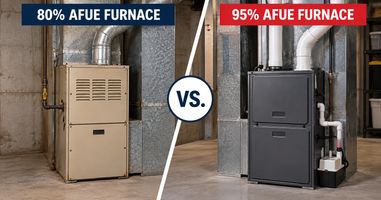
A typical 80 AFUE furnace is a non-condensing furnace. Enough heat remains in the combustion gases that they can generally be exhausted through a metal vent pipe.


A 95 AFUE furnace is a condensing furnace. It captures additional heat from the combustion gases using a secondary heat exchanger.


Cooling those gases further creates water vapor that condenses into liquid which changes two parts of the installation.


First, the furnace requires venting appropriate for a condensing system. Second, the condensate produced during operation has to be properly drained.


This is why replacing an existing 80% furnace with a high-efficiency furnace is not always a simple matter of removing one cabinet and putting another in the same spot.

Existing Venting Can Influence the Replacement Decision

If your home already has an 80% furnace, the existing venting is worth reviewing before purchasing replacement equipment.


An 80% furnace may use a metal flue or chimney-based vent, depending on the installation. A high-efficiency condensing furnace uses a PVC vent because its exhaust is cooler and contains moisture. Because of this, changing furnace efficiency can also mean changing the venting configuration.


The exact requirements depend on the furnace, the building, the installation location, and applicable installation requirements. An HVAC professional should review the existing system before equipment is purchased.


This especially matters when a furnace is located where routing new vent piping to the exterior would be difficult or require significant changes to the building.

A 95% Furnace Also Needs a Plan for Condensate

Condensate is another difference homeowners sometimes overlook while comparing furnace specifications. Because a 95% furnace removes more heat from the combustion gases, water forms during operation and tat water needs somewhere to go.


The installation needs a way to manage and drain condensate. Depending on where the furnace is located, that may be relatively straightforward or may require additional planning. For example, a furnace near a drain is a different situation than one located in an area where drainage is difficult. Cold locations can introduce additional considerations because condensate and drain piping need to function properly during heating weather.


This doesn't make a high-efficiency furnace a poor choice. It simply means furnace efficiency should be considered together with the installation requirements it creates.

Is a 95% Furnace Always the Better Choice?

Not automatically.


A 95% furnace uses fuel more efficiently than an 80% model, but the decision should consider the complete replacement project.


Climate can affect the value of higher efficiency because furnaces generally operate more in colder areas. The condition and efficiency of the home also matter. Insulation, air sealing, windows, ducts, and the home's actual heating load all influence how much heating energy is required.


Installation conditions are just as important. If switching from an 80% furnace requires substantial changes to venting or condensate drainage, those changes become part of the project. In another home, installing a condensing furnace may be relatively uncomplicated.


This is why comparing AFUE ratings without looking at the existing mechanical setup can give you an incomplete picture.

Furnace Efficiency Does Not Replace Proper Sizing

An efficient furnace still needs to be properly sized for the building. A common shopping mistake is to assume that matching the BTU number on an older furnace is enough. The existing furnace is useful as a reference, but it does not prove that the original equipment was sized correctly.


The home's heating load may also have changed. Added insulation, replacement windows, air sealing, additions, renovations, and other changes can affect how much heating capacity is needed.


Pay attention to the distinction between furnace input and output as well. A higher-efficiency furnace can provide a different amount of usable heat than a lower-efficiency furnace with the same input rating.


Have the heating requirement and proposed equipment capacity confirmed before ordering rather than selecting a furnace based only on the old nameplate.

Look Beyond AFUE When Comparing Furnaces

Once you've decided which efficiency range fits the project, there are still other furnace specifications to compare. Check factors such as:


• Heating input and output capacity

• Furnace orientation, including upflow, downflow, or horizontal configurations

• Cabinet dimensions and available installation space

• Blower specifications

• Single-stage, two-stage, or other heating operation

• Electrical requirements

• Venting requirements

• Condensate requirements for condensing furnaces

• Compatibility with the home's air conditioning and duct system


Two furnaces with similar AFUE ratings and BTU capacities are not necessarily interchangeable.


If you're purchasing the equipment separately from installation, having your HVAC technician review the complete model number and specifications before ordering can help prevent compatibility problems.

Questions to Ask Before Choosing an 80% or 95% Furnace

The most useful question isn't simply, “Which furnace is more efficient?” Ask what the change means for your particular home. Before purchasing, have your HVAC professional help determine:


• What heating capacity does the home actually require?

• What type of furnace and airflow orientation fits the existing installation?

• Can the current venting arrangement be used with the proposed furnace?

• Would switching to a condensing furnace require new vent piping?

• Where will condensate drain if a high-efficiency furnace is installed?

• Are the furnace dimensions appropriate for the available space?

• Will the furnace work properly with the remaining HVAC components?


These questions help turn an AFUE comparison into an equipment decision based on the actual project.


Compare the Furnace and the Installation Together

The 80 vs 95 furnace decision involves more than choosing the higher efficiency percentage.


An 80% furnace may fit naturally into some existing replacement situations, while a 95% condensing furnace can offer greater fuel efficiency when the home and installation support it. Venting, condensate drainage, heating capacity, configuration, and system compatibility all deserve attention before equipment is ordered.


Public HVAC Solutions carries HVAC equipment and gas furnaces in different capacities, efficiency ratings, configurations, and equipment specifications. Review the complete product details and have your HVAC professional confirm sizing and compatibility before purchasing.

Let’s create what matters — together.

More Posts

R-454B vs. R-410A: What Changes When Replacing HVAC Equipment?R-454B vs. R-410A: What Changes When Replacing HVAC Equipment?
R-454B vs. R-410A: What Changes When Replacing HVAC Equipment?

Replacing an air conditioner used to start with familiar questions about tonnage, efficiency, electrical requirements, and equipment compatibility. Now there is another specification that deserves attention before anything is ordered: refrigerant.


The transition from R-410A to lower-global-warming-potential refrigerants such as R-454B has created some understandable confusion. An existing R-410A system does not automatically need to be replaced just because newer equipment uses another refrigerant. At the same time, an R-454B condenser should not be treated as a direct substitute for an R-410A condenser.


Understanding R-454B vs R-410A is especially important when only one major HVAC component has failed.
How to Read Your HVAC Nameplate Before Shopping for Replacement EquipmentHow to Read Your HVAC Nameplate Before Shopping for Replacement Equipment
How to Read Your HVAC Nameplate Before Shopping for Replacement Equipment

Shopping for replacement HVAC equipment is much easier when you know exactly what is already installed. One of the best places to start is the equipment nameplate.


If you're trying to read an HVAC nameplate, you do not need to understand every number printed on it. Your first job is simply to find the plate, take clear pictures, and identify a few useful pieces of information such as the manufacturer, model number, refrigerant, electrical requirements, and capacity-related details.


Those details can help an HVAC professional or equipment supplier understand what you currently have. They can also reduce the risk of shopping for equipment based only on square footage, tonnage, or a partial model number.

What Is an AHRI Matched HVAC System, and Why Does Matching Matter?What Is an AHRI Matched HVAC System, and Why Does Matching Matter?
What Is an AHRI Matched HVAC System, and Why Does Matching Matter?

Shopping for a new central air conditioning system can look straightforward at first. You need a certain tonnage, so you find a condenser with that capacity, pair it with an indoor coil of the same general size, and you should have a complete system.


Not necessarily.


Split HVAC equipment is made up of components that operate together. The fact that two pieces of equipment are both labeled 3 ton, for example, does not prove that they are a certified combination. An AHRI matched system gives buyers another piece of information. It identifies a specific combination of indoor and outdoor equipment whose performance has been certified together.


Understanding that distinction is useful before buying a condenser, coil, furnace, air handler, or complete matched AC system.

Can You Replace Just the Outside AC Unit? What Homeowners Need to KnowCan You Replace Just the Outside AC Unit? What Homeowners Need to Know
Can You Replace Just the Outside AC Unit? What Homeowners Need to Know

If your central air conditioner’s outdoor unit fails, replacing the entire cooling system may seem like the obvious next step. But that is not always necessary.


In some situations, you can replace the outside AC unit and continue using the existing indoor equipment. The important part is determining whether the new condenser can properly work with the evaporator coil, furnace or air handler, refrigerant, controls, and other components already in place.


That means a condenser-only replacement should not be based on tonnage alone. Before ordering equipment, the complete system needs to be evaluated.

What Size HVAC System Do I Need? What Size HVAC System Do I Need?
What Size HVAC System Do I Need?

If you're replacing an air conditioner or shopping for a new HVAC system, one of the first questions is usually, “What size HVAC system do I need?”


Square footage can help you begin narrowing your options, but it cannot give you the final answer by itself. The same is true of the tonnage printed on your existing air conditioner. Both are useful pieces of information, but neither tells the complete story.


For residential cooling, the amount of capacity a home needs depends on how much heat the home actually gains under expected conditions. Size, insulation, windows, air leakage, climate, orientation and several other characteristics can change that load.


Understanding that distinction can help you shop more intelligently before an HVAC professional confirms the final equipment selection.

What Homeowners Should Know Before Buying HVAC Equipment OnlineWhat Homeowners Should Know Before Buying HVAC Equipment Online
What Homeowners Should Know Before Buying HVAC Equipment Online

Buying heating and cooling equipment separately from installation can give homeowners more control over the purchase. It also changes who is responsible for confirming the details before the order is placed.


If you plan to buy HVAC equipment online, do not treat it like a standard appliance purchase. A furnace, air conditioner, heat pump, coil, or complete split system has to fit the home, work with the other components, meet the installation requirements, and arrive in usable condition.