
WE SHIP NATIONWIDE ACROSS THE UNITED STATES AND CANADA. SPEAK TO AN EXPERT: 708-400-7000

6 days ago

How to Read Your HVAC Nameplate Before Shopping for Replacement Equipment

Shopping for replacement HVAC equipment is much easier when you know exactly what is already installed. One of the best places to start is the equipment nameplate.


If you're trying to read an HVAC nameplate, you do not need to understand every number printed on it. Your first job is simply to find the plate, take clear pictures, and identify a few useful pieces of information such as the manufacturer, model number, refrigerant, electrical requirements, and capacity-related details.


Those details can help an HVAC professional or equipment supplier understand what you currently have. They can also reduce the risk of shopping for equipment based only on square footage, tonnage, or a partial model number.

What Is an HVAC Nameplate?

An HVAC nameplate, sometimes called an HVAC data plate or rating plate, is a label attached to the equipment that contains identifying and technical information about that specific unit. Depending on the equipment, you may find information such as:


• Manufacturer

• Model number

• Serial number

• Voltage

• Electrical phase

• Frequency

• Refrigerant type

• Cooling or heating capacity information

• Fuel information

• Electrical ratings

• Certification or manufacturing information


Not every nameplate uses the same layout or terminology. A furnace nameplate will not necessarily show the same information as an outdoor AC condenser, heat pump, air handler, or evaporator coil.


That is one reason taking a clear picture is usually more useful than copying down one or two numbers.

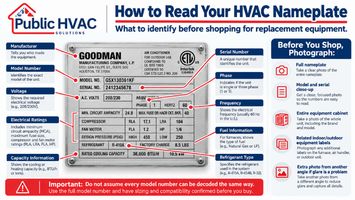
How to read your HVAC nameplateHow to read your HVAC nameplate

Where to Find the HVAC Data Plate

Start by looking on the exterior cabinet of the equipment. Outdoor condensers and heat pumps commonly have a label attached to one of the exterior panels.


Indoor equipment can require a little more searching. A furnace or air handler may have the nameplate on the exterior cabinet, behind an accessible service panel, or near another equipment identification label.


Do not remove electrical panels or reach into energized equipment just to find a model number. If the label is not readily accessible, have your HVAC technician locate it.


For a split HVAC system, remember there is more than one piece of equipment. You may need identification information from the outdoor condenser or heat pump as well as the furnace, air handler, or indoor coil.

What to Take a Picture of Before You Start Shopping

A single close-up is not always enough. Labels can be faded, scratched, dirty, or difficult to read, and one picture may cut off information that becomes useful later. A better approach is to take:


A clear picture of the entire nameplate.

Make sure all four edges of the label are visible.


A close-up of the model and serial numbers.

These characters are easy to confuse, especially zeros, letters, and similar-looking numbers.


A picture of the complete piece of equipment.

This gives useful context about the cabinet and installation.


Pictures of related HVAC equipment.

If you're replacing only part of a split system, take a picture of the nameplates on the components that will remain.


An extra picture without flash if glare is a problem.

Reflective labels can become unreadable when photographed directly with a phone flash.


Do not crop the image too tightly. Information that seems unimportant at first may matter when someone is trying to identify the equipment later.

How to Read the HVAC Model Number

The HVAC model number is one of the most useful pieces of information on the plate. For an outdoor unit, you may also hear it called the AC model number or heat pump model number. Furnaces, coils, air handlers, packaged equipment, and other HVAC components have their own model numbers as well.


Copy the model number exactly as printed, including letters, numbers, dashes, and other characters.


This matters because model numbers can identify far more than the general equipment type. Depending on the manufacturer and product family, characters within the model may correspond to capacity, cabinet size, configuration, efficiency family, electrical characteristics, or other product details.


There is an important catch. Do not assume every HVAC model number can be decoded using the same pattern.


Some manufacturers use recognizable capacity codes or product-family conventions. Others use different systems, and those conventions can change between equipment generations. A code that means one thing on one brand or product line may mean something completely different on another.


Use the complete model number to identify the unit. Do not rely on a few characters unless the decoding method has been confirmed for that exact equipment family.

Check the Manufacturer and Equipment Type

Before trying to interpret any technical information, identify who made the equipment and what kind of component you are looking at.


The manufacturer name is usually clearly marked on the plate, although the brand shown on the cabinet may not always tell you everything about the underlying product family.


Also determine whether the label belongs to a furnace, air conditioner condenser, heat pump, air handler, evaporator coil, packaged unit or an other HVAC component


This distinction matters because similar-looking specifications can mean different things on different equipment.


If you're shopping for complete replacement equipment, you can compare available options in Public HVAC Solutions' HVAC Equipment category after gathering the identification information from your existing system.

Find the Refrigerant Information

Outdoor air conditioners, heat pumps, coils, and other refrigeration-system components may identify the refrigerant associated with the equipment. Record the refrigerant exactly as shown.


Do not assume that a replacement component is compatible simply because it has the same nominal capacity as the old one. Refrigerant compatibility is one of several details that must be checked when components are being matched.


This becomes especially important when only one portion of an existing system is being replaced. The outdoor unit, indoor coil, metering components, and other system requirements need to work together.


Your HVAC technician should confirm compatibility before equipment is purchased.

Understand HVAC Voltage and Phase

The nameplate can also provide important electrical information. Two fields that deserve particular attention are voltage and phase.


Voltage identifies the electrical supply the equipment is intended to use. Phase tells you whether the equipment is designed for single-phase or three-phase electrical service.

Do not treat these specifications as interchangeable.


Equipment with the correct capacity but the wrong electrical requirements may not be appropriate for the installation. Three-phase equipment, for example, is commonly encountered in commercial applications and requires the appropriate electrical service.


You may also see other electrical ratings on the plate. These can be important to the installer, but homeowners do not need to interpret every abbreviation themselves.


Take a picture of the full label so the complete electrical information is visible.

Look for Capacity Information, but Do Not Size a Replacement From the Plate Alone

Your existing nameplate may contain capacity-related information directly, or the capacity may be associated with the model number.


Cooling equipment is commonly discussed in BTUs per hour or tons. Furnaces may list heating input and output information.


These numbers provide useful clues about the equipment currently installed. They do not automatically tell you what the replacement equipment should be.


A home or building may have changed since the old system was installed. Insulation, windows, additions, air sealing, occupancy, ductwork, and other conditions can affect heating and cooling requirements.


Use the old capacity as a reference point. Have the required replacement capacity confirmed rather than assuming the old equipment size must be duplicated.


For homeowners comparing central equipment, Public HVAC Solutions' Residential HVAC Equipment category can also help narrow the types of systems available once your installer has confirmed the application and required capacity.

Do Not Stop After Finding One Model Number

This is one of the easiest mistakes to make when trying to identify HVAC equipment.


A central split system may have several separate components, each with its own model number and nameplate.


For example, replacing an outdoor air conditioner may require information about the indoor coil and furnace or air handler that will remain in place. Replacing an indoor component may require the outdoor unit information as well.


Before shopping, collect the model numbers and nameplate pictures for every component involved in the existing system.


If you're looking for a smaller replacement component rather than complete equipment, Public HVAC Solutions also carries HVAC Parts & Supplies. For parts, the original equipment model and the information printed on the old component can both be useful when confirming a replacement.

What If the HVAC Nameplate Is Faded or Missing?

Older equipment labels are not always easy to read.


If the nameplate is faded, try taking a picture from several angles and under different lighting. Avoid guessing at unclear characters. A single incorrect letter or number can point to a completely different model.


Other useful places to look can include equipment paperwork, installation records, previous service invoices, labels elsewhere on the cabinet, or information retained by your HVAC contractor.


If the complete model cannot be confirmed, do not try to fill in the missing characters based on a similar-looking model found online. Have the equipment identified before ordering a replacement.

Let’s create what matters — together.

Use the Nameplate as a Starting Point, Not the Final Equipment Selection

Learning how to read an HVAC nameplate gives you a much better starting point for replacement shopping.


Get clear pictures of the complete plate and record the manufacturer, full model number, refrigerant, voltage, phase, and available capacity information. For split systems, gather the information from the other components too.


Then have an HVAC professional confirm sizing, system compatibility, electrical requirements, and the installation details before you order.


Once those details are understood, you can Shop HVAC Systems through Public HVAC Solutions and compare equipment that fits the requirements of your project.

More Posts

What Is an AHRI Matched HVAC System, and Why Does Matching Matter?What Is an AHRI Matched HVAC System, and Why Does Matching Matter?
What Is an AHRI Matched HVAC System, and Why Does Matching Matter?

Shopping for a new central air conditioning system can look straightforward at first. You need a certain tonnage, so you find a condenser with that capacity, pair it with an indoor coil of the same general size, and you should have a complete system.


Not necessarily.


Split HVAC equipment is made up of components that operate together. The fact that two pieces of equipment are both labeled 3 ton, for example, does not prove that they are a certified combination. An AHRI matched system gives buyers another piece of information. It identifies a specific combination of indoor and outdoor equipment whose performance has been certified together.


Understanding that distinction is useful before buying a condenser, coil, furnace, air handler, or complete matched AC system.
Can You Replace Just the Outside AC Unit? What Homeowners Need to KnowCan You Replace Just the Outside AC Unit? What Homeowners Need to Know
Can You Replace Just the Outside AC Unit? What Homeowners Need to Know

If your central air conditioner’s outdoor unit fails, replacing the entire cooling system may seem like the obvious next step. But that is not always necessary.


In some situations, you can replace the outside AC unit and continue using the existing indoor equipment. The important part is determining whether the new condenser can properly work with the evaporator coil, furnace or air handler, refrigerant, controls, and other components already in place.


That means a condenser-only replacement should not be based on tonnage alone. Before ordering equipment, the complete system needs to be evaluated.

What Size HVAC System Do I Need? What Size HVAC System Do I Need?
What Size HVAC System Do I Need?

If you're replacing an air conditioner or shopping for a new HVAC system, one of the first questions is usually, “What size HVAC system do I need?”


Square footage can help you begin narrowing your options, but it cannot give you the final answer by itself. The same is true of the tonnage printed on your existing air conditioner. Both are useful pieces of information, but neither tells the complete story.


For residential cooling, the amount of capacity a home needs depends on how much heat the home actually gains under expected conditions. Size, insulation, windows, air leakage, climate, orientation and several other characteristics can change that load.


Understanding that distinction can help you shop more intelligently before an HVAC professional confirms the final equipment selection.

What Homeowners Should Know Before Buying HVAC Equipment OnlineWhat Homeowners Should Know Before Buying HVAC Equipment Online
What Homeowners Should Know Before Buying HVAC Equipment Online

Buying heating and cooling equipment separately from installation can give homeowners more control over the purchase. It also changes who is responsible for confirming the details before the order is placed.


If you plan to buy HVAC equipment online, do not treat it like a standard appliance purchase. A furnace, air conditioner, heat pump, coil, or complete split system has to fit the home, work with the other components, meet the installation requirements, and arrive in usable condition.