

WE SHIP NATIONWIDE ACROSS THE UNITED STATES AND CANADA.

9 hours ago

What Size HVAC System Do I Need?

If you're replacing an air conditioner or shopping for a new HVAC system, one of the first questions is usually, “What size HVAC system do I need?”


Square footage can help you begin narrowing your options, but it cannot give you the final answer by itself. The same is true of the tonnage printed on your existing air conditioner. Both are useful pieces of information, but neither tells the complete story.


For residential cooling, the amount of capacity a home needs depends on how much heat the home actually gains under expected conditions. Size, insulation, windows, air leakage, climate, orientation and several other characteristics can change that load.


Understanding that distinction can help you shop more intelligently before an HVAC professional confirms the final equipment selection.

What Does HVAC Size Actually Mean?

For central air conditioning, HVAC size usually refers to cooling capacity.

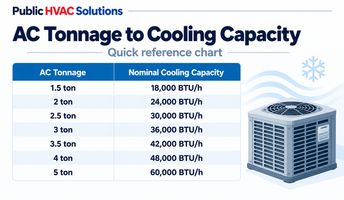
Cooling systems are commonly described in tons, with one ton of cooling capacity equal to approximately 12,000 BTU per hour. The chart below gives the cooling capacity for AC tonnages.

AC Tonnage quick reference chartAC Tonnage quick reference chart

This tells you the nominal capacity of the equipment. It does not tell you what capacity your particular home requires.


Heating equipment is sized differently. A furnace, for example, is commonly described by its heating input and output in BTUs. A home that needs a certain AC tonnage does not automatically require a furnace with a corresponding heating capacity.


That is why HVAC sizing needs to consider cooling and heating loads rather than treating the entire system as one simple square-foot calculation.

HVAC Sizing by Square Footage Is Useful, but Limited

Many shoppers naturally start with the size of the house. Searching for HVAC sizing by square footage or AC tonnage by square feet can help narrow a large equipment selection into a more manageable range.


Public HVAC Solutions also uses square-foot ranges on some equipment categories to make browsing easier. For example a 2-ton package covers 900-1400 sq ft while a 4-ton package covers 2101-2700 sq ft. These ranges are useful for shopping and preliminary research, not as a substitute for an HVAC load calculation.


Two 2,000-square-foot homes may have very different cooling requirements. One might be newer, well insulated and shaded for much of the day. Another might have older windows, substantial western exposure, more air leakage and less insulation. The floor area is the same. The amount of heat entering the home is not.


That is the problem with treating a square-footage chart as a sizing formula. It gives you a starting point without accounting for the building itself.

What Determines the HVAC Size a Home Needs?

An HVAC professional needs to look beyond the number of square feet being conditioned.

Factors that can affect cooling and heating loads include:


• Local climate and outdoor design temperatures

• Insulation levels in walls, ceilings and other building areas

• Window quantity, size, type and orientation

• Sun exposure and shading

• Air leakage through the building envelope

• Ceiling height

• Duct location and condition

• Building orientation

• Internal heat generated by occupants, appliances and other sources

• The amount of conditioned space


Some factors have more influence than others, and the answer changes from one house to another. This is why a homeowner can use square footage to start researching equipment without assuming the first tonnage chart they find is a final equipment recommendation.

What Is a Manual J Load Calculation?

Manual J is the residential load-calculation method used to determine how much heating and cooling a home requires under specific design conditions.


Instead of saying, “This house is 2,000 square feet, so it needs X tons,” the calculation evaluates characteristics of the home that affect heat gain and heat loss.


The resulting load is expressed in BTUs per hour. That information can then be used as part of the equipment-selection process.


For homeowners, you do not need to understand every formula behind a Manual J calculation. The important distinction is simpler:

Square footage describes how large the house is. A load calculation estimates how much heating and cooling the house actually needs.


That makes the load calculation much more useful when making a final sizing decision.

Should I Replace My AC With the Same Tonnage?

Sometimes the existing AC tonnage will turn out to be appropriate. But replacing an AC with the same tonnage should not be automatic. The old unit is useful information. It tells your HVAC professional what was installed previously and gives you a starting point when researching replacement equipment.


What it does not prove is that the system was sized correctly in the first place. There are several reasons the correct replacement capacity could be different. The previous system may have been selected using a rough sizing rule. The home may also have changed since that equipment was installed. New windows, added insulation, air sealing, an addition or other building modifications can change heating and cooling loads.


A homeowner may also assume a larger unit is safer because it provides more cooling capacity. Bigger is not automatically better. Equipment selection should be based on the building's actual needs, not simply on choosing more capacity as insurance.


The same applies in the opposite direction. Reducing tonnage simply because newer equipment is more efficient does not automatically mean the smaller capacity is appropriate. Start with the existing model and tonnage, then have the required capacity confirmed before ordering replacement equipment.

Why Tonnage Is Only One Part of Buying Replacement Equipment

Even after you know the appropriate capacity, you still have more specifications to check.

Two 3-ton air conditioners, for example, are not automatically interchangeable just because both have the same nominal cooling capacity.


Depending on the system, you may also need to verify the refrigerant, indoor coil, electrical requirements, efficiency, airflow requirements and equipment combination.

This is especially important if you are replacing only one component of a split HVAC system. The sizing question comes first: How much capacity does the building need?


The compatibility question comes next: Which equipment can properly provide that capacity as part of this HVAC system?


Keeping those two decisions separate can prevent a common shopping mistake: finding equipment with the correct tonnage and assuming everything else will match.

You can review broader equipment options in the HVAC Equipment category once the capacity and system requirements have been identified.

Can an HVAC System Be Too Large?

Yes. Installing more capacity than a home needs is not necessarily an advantage. An oversized cooling system may satisfy the thermostat quickly, but equipment operation involves more than simply lowering the temperature. Runtime, airflow and moisture removal all contribute to indoor comfort.


A system that is substantially larger than the actual cooling load may operate differently than equipment selected around the home's needs. Undersizing has its own problems. Equipment that does not have enough capacity for the actual load may struggle during demanding conditions.


This is why the goal is not to buy the largest unit that fits the budget or to find the smallest unit that might work. The objective is to match equipment capacity to the calculated load and the rest of the HVAC system.

How to Shop for HVAC Equipment Before You Know the Exact Size

You do not need to wait until every specification is finalized before doing research. Square footage, your existing equipment and basic property information can all help you understand what types of systems and capacities are available. Before ordering, however, gather as much information as possible:

• Conditioned square footage

• Existing AC tonnage

• Existing equipment model numbers

• Heating capacity

• Fuel type

• Refrigerant

• Indoor and outdoor equipment information

• Any major improvements made since the current system was installed


Then have an HVAC professional confirm the heating and cooling loads and verify that the equipment being considered is appropriate for the complete system. Homeowners shopping for central residential equipment can also browse Residential HVAC Equipment to get a better sense of available system types and capacities.

Start With the Range, Then Confirm the Load

If you're trying to answer “what size HVAC system do I need?”, square footage is a reasonable place to begin. Your current AC tonnage is another useful clue.

Neither should make the final decision for you.


A proper HVAC load calculation looks at how the home actually gains and loses heat. Once the required capacity is understood, you can compare equipment that meets those needs and then confirm the remaining compatibility requirements.


That approach gives homeowners and HVAC professionals a better starting point for selecting equipment without treating a simple square-footage chart or an old nameplate as the complete sizing answer.

More Posts

What Homeowners Should Know Before Buying HVAC Equipment OnlineWhat Homeowners Should Know Before Buying HVAC Equipment Online
What Homeowners Should Know Before Buying HVAC Equipment Online

Buying heating and cooling equipment separately from installation can give homeowners more control over the purchase. It also changes who is responsible for confirming the details before the order is placed.


If you plan to buy HVAC equipment online, do not treat it like a standard appliance purchase. A furnace, air conditioner, heat pump, coil, or complete split system has to fit the home, work with the other components, meet the installation requirements, and arrive in usable condition.